|
We provide turn-key solutions for Voicerecording, Screenrecording and Quality management. Use these technologies for legal bulk recording, or for Quality Assurance and Training.
Legal bulk call recording
Here your goal is to record all conversations for regulatory reasons, or in order to have a proof of a customer order.
- Typically this generates large amount of data that has to be kept for several years. Voice is typically highly compressed, and we recommend you to provide a network storage device or DAT/ DVD's to store the media on regular intervals.
- Voice recorders can be configure ALL data and conversations => this produces high volume of files, generates network traffic, and for systems that are priced per concurrent voicechannel are more costly.
|
 |
- They can also be configured to allow on-demand recording. This allows your agents to press a button on the phone or on the screen, which will result in that particular conversation to be recorded (either from that point on forward, or from the beginning of the conversation). This is useful in case of abusive callers, or to record calls that contain legally important information.
- An interesting feature here is CALL TAGGING. While the call is being recorded, we retrieve some information from an application on the agent's desktop, which can be used later on to retrieve that particular recording directly from your business application. For example, if you use recording in a trading environment, we could capture the ID of an executed trade on the agent's desktop, and tag the voicecall with the trade ID. This allows you later on to easily find the conversation where you will find the proof that this conversation actually happened.
- .. and if you haven't done calltagging in the past, but have done only voice recording - don't despair. We can use sophisticated audio mining technologies fine-tuned to your environment and interactions. We can find certain keywords in your audio files, and match these with business transactions.
Quality Assurance in the callcenter
In the case of quality management, the business goal is to measure and improve your customer service quality.
- A very small subset of all conversations are recorded, with the goal of coaching and training agents. Agents are typically coached by a very limited number of callcenter supervisors within 1-2 months at the latest after the conversation. After this period, recordings are no further required. It doesn't make sense to record for quality management purposes more channels than you have supervisors that can actually listen to the recordings.
- Often, not only the calls, but also the screen is recorded, to verify if the agent is using his desktop tools appropriately. The supervisor later uses a quality management tool while listening to the conversation and seeing the screenrecording. He does this on a subset of conversations per agent per month (say ten randomly recorded conversations). The quality management tool allows the supervisor to score the conversations per agent along defined criteria, for example the greeting, whether the agent repeated the caller's name, whether he spoke clearly, used the tools appropriately, captured the customers requirements appropriately etc.
- These scores are then summarized per agent or per group or over the whole callcenter during a time period (say, one month). These reports can be aggregated with Real-Time Adherence reports from the Workforce Management tools (ie, whether the agents worked when they were scheduled to work and took their brakes when scheduled). Together, these performance reports will give a 360° assessment of each agent, and help to identify training and coaching needs.
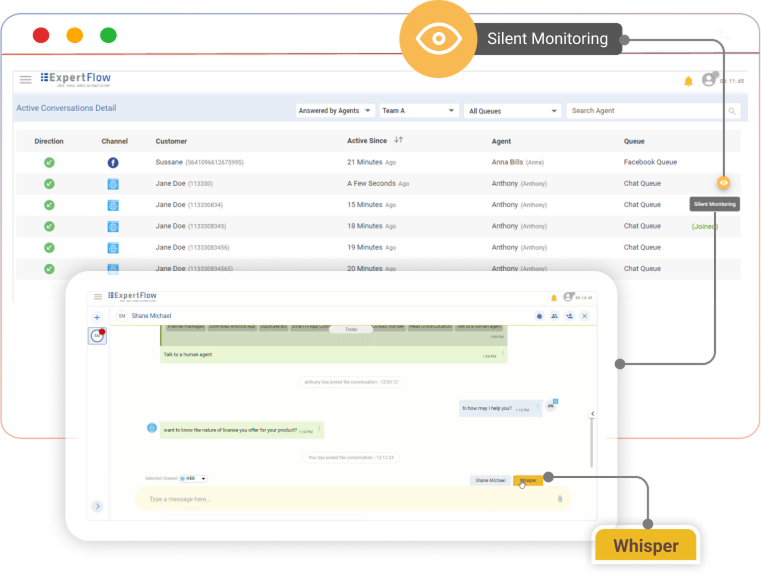
- The supervisor can also barge in real-time into a conversation and see the agent’s screen, and force a recording to take place. Alternatively, he can simply do silent monitoring without entering the conversation actively.
Interested? Contact us via chat for a free online WWW-based demonstration of Voice Recording Tools and Solutions by one our consultants!
|